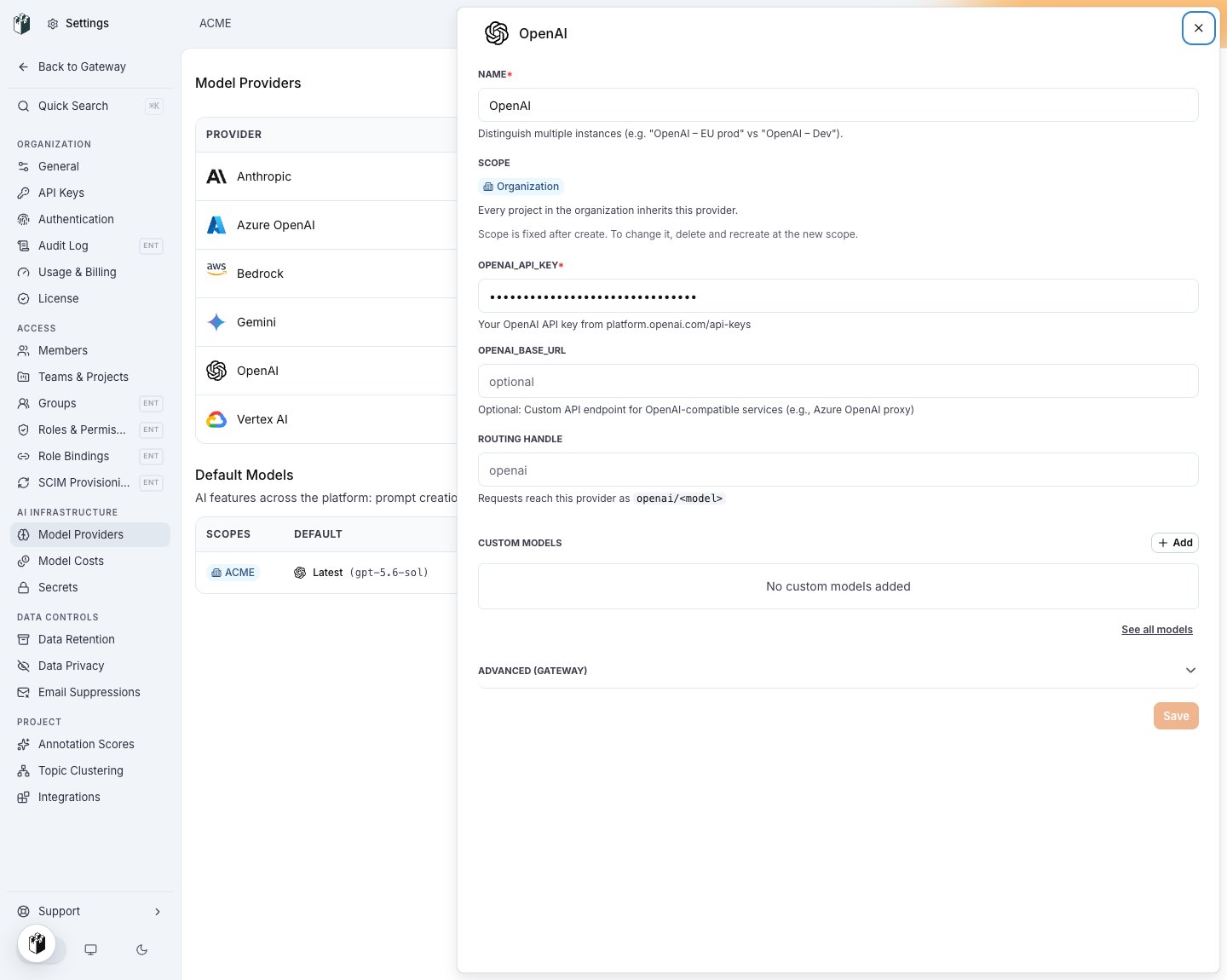
OpenAI is the most straightforward provider to bind to the gateway. Any valid OpenAI API key in your LangWatch Model Providers table can be referenced by a virtual key and consumed via /v1/chat/completions, /v1/embeddings, /v1/responses, /v1/images/generations, /v1/audio/transcriptions, and /v1/audio/speech.

Configure the provider credential

Under Settings → Model Providers in the LangWatch app:
  1. Click Add providerOpenAI.
  2. Paste your OpenAI API key (starts sk-...).
  3. Optionally set a custom organisation ID via the Organization field.
  4. Save.
This creates a ModelProvider row that any VK in the same project can bind to. The same credential also powers the existing litellm, playground, evaluators path, no duplication.

Bind the credential to a VK

When creating or editing a VK, select the OpenAI credential from the Primary provider dropdown. Optionally add it again (or a second OpenAI key) as a fallback. Per-VK overrides available on the binding:
  • Rate limits: per-VK rpm, tpm, rpd enforced at the gateway before the upstream call.
  • Extra headers: appended to every request (e.g. OpenAI-Beta: assistants=v2).
  • Rotation policy: when a credential has multiple API keys (comma-separated), the gateway can rotate them round-robin or on rate-limit.

Supported endpoints

Gateway routeUpstreamNotes
POST /v1/chat/completionsPOST /v1/chat/completionsStreaming and non-streaming both supported.
POST /v1/responsesPOST /v1/responsesReasoning models (o3, o4-mini) and tool use.
POST /v1/embeddingsPOST /v1/embeddingstext-embedding-3-small, text-embedding-3-large, ada.
POST /v1/images/generationsPOST /v1/images/generationsDALL-E 3.
POST /v1/audio/transcriptionsPOST /v1/audio/transcriptionsWhisper.
POST /v1/audio/speechPOST /v1/audio/speechTTS.
POST /v1/moderationsPOST /v1/moderationsContent moderation.
GET /v1/modelsGET /v1/modelsFiltered by the VK’s models_allowed.

Caching

OpenAI automatically caches prompt prefixes ≥ 1024 tokens in most GPT-4, GPT-5, o-series models. There’s no cache_control block to preserve, OpenAI just handles it. The gateway forwards requests untouched in mode=respect, so cache hits are observed naturally. The usage.prompt_tokens_details.cached_tokens field in the response is populated on cache hits and mirrored into the trace as gen_ai.usage.cache_read.input_tokens (OTel GenAI semconv). OpenAI has no write-to-cache dimension, so gen_ai.usage.cache_creation.input_tokens is unset.

Reasoning tokens (o-series)

Reasoning models return a reasoning_tokens count in usage.completion_tokens_details. The gateway forwards this verbatim; it’s also recorded in the LangWatch trace for cost analysis and included in budget debit.

Known quirks

  • Responses API vs Chat Completions API: the two have slightly different payload shapes. The gateway proxies whichever endpoint the client hits; it does not translate between them. Codex users should see Codex CLI for guidance on wire_api config.
  • Organization header on egress: if the VK doesn’t set a custom Organization, the upstream OpenAI request uses the ModelProvider’s default.
  • Rate-limit responses (429): OpenAI’s 429 includes a Retry-After header the gateway surfaces to the client when there is no fallback, or uses as a signal to trigger fallback if fallback.on includes rate_limit.