

What is an Instant Eval
An Instant Eval is a question in plain words, judged against every row in a time window of your history. For example, “the customer sounds frustrated” over the last 30 days of conversations comes back as a yes or no per conversation, with the probability behind it, and the count across all of them. Every row is judged rather than a sample, so the one conversation in ten thousand where the agent promised a refund it cannot give is in the result. The judge is a small calibrated model: 10,000 conversations take about a minute and cost well under a dollar, and 1,000 rows take about nine seconds. The judge is run by a third-party provider, so the judged text leaves LangWatch for the length of the run. Where the judged text goes says exactly what is sent, and under what agreement.Your first run
Install the CLI and sign in to the project that holds your traces: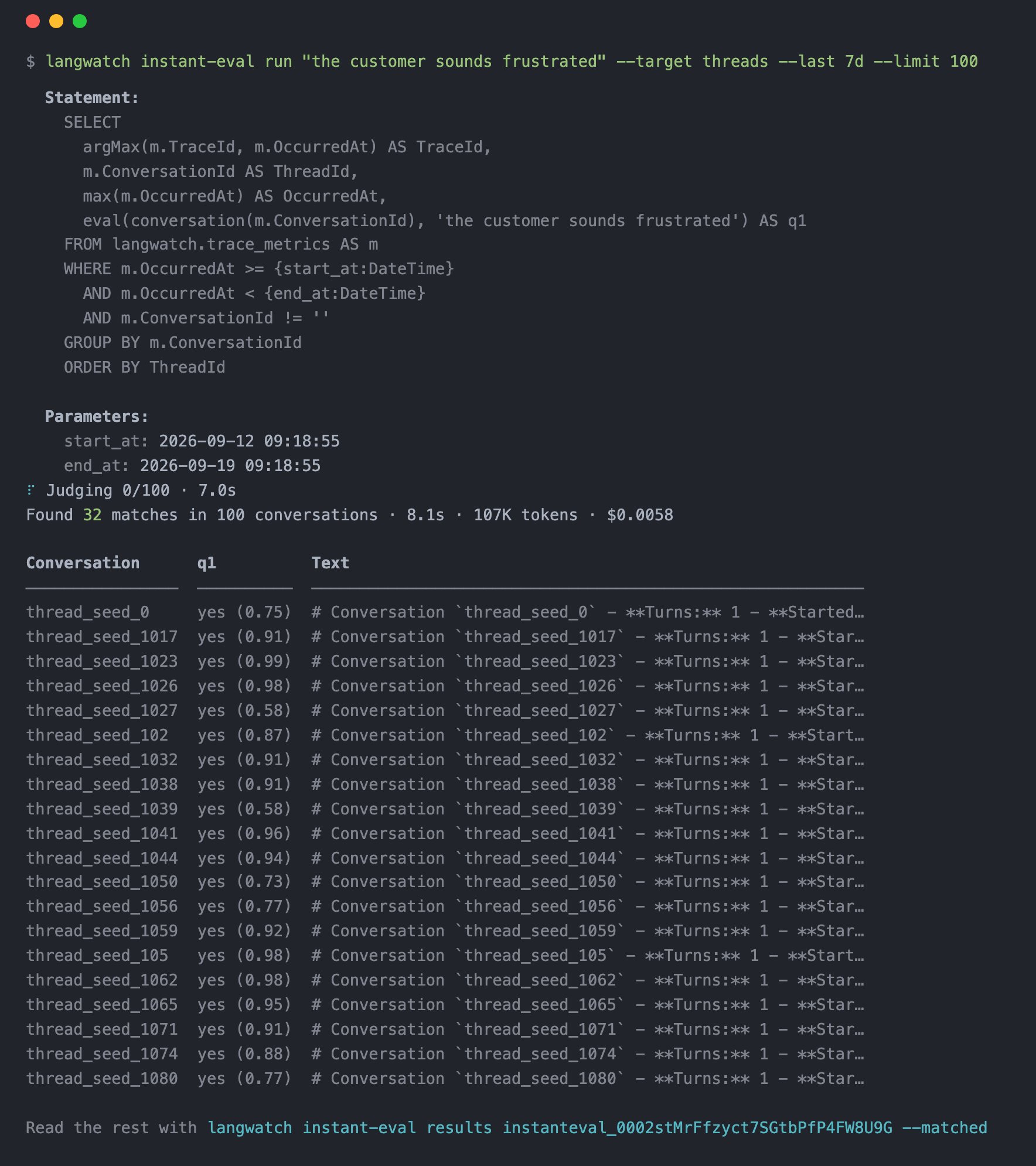
The first run over 100 conversations: the statement it wrote, the progress line, then the headline with 32 matches in about 8 seconds and the first 20 of them.
What comes back
In the headline you get how many rows matched, how long it took, how many tokens the judge read and what that cost. Under it, one line per matched row: the conversation, the answer with its probability, and the start of the text that was judged. Read every match, and check what the judge actually read, with the run id from the headline:results you page through the verdicts. With sample you read a few rows, the judged text beside each verdict, and check that you asked what you meant. Every verdict is also a row in the judgments dataset, so a LangWatchQL query can join it back to your traces. See Reading the results.
Sample, read, refine, then run wide
- Run the question on a hundred rows with
--limit 100. - Read what the judge saw with
sample. - Refine the question and run the same hundred again.
- Check the cost, then run wide.
--criteria:
estimate, then start it. A run over 1,000 rows prints its cost before it starts either way. Pass --detach to get the run id straight away instead of waiting, and follow it with status --wait:
Three ways to run one
The CLI
langwatch instant-eval run waits for the run and prints the matches. Every flag and
subcommand.The REST API
POST /api/v1/instant-evals answers 202 with a queued run. Poll it, page through its results,
sample and cancel it.Langy
Ask the question in the chat panel. Langy runs
langwatch instant-eval in its sandbox and reads
the matches back to you.Reference
Questions
Yes or no, criteria, thresholds, scores, categories, several questions at once, and a questions
file.
Targets and statements
What one row is, the time window, the trace filter, the statement each target writes, and
writing your own.
Results
Paging through verdicts, sampling the judged text, and the
judgments dataset in LangWatchQL.Limits and cost
Row caps, the question cap, the text budget, speed, the rate per token, the free budget and
billing.