> ## Documentation Index
> Fetch the complete documentation index at: https://langwatch.ai/docs/llms.txt
> Use this file to discover all available pages before exploring further.
> ## Agent Instructions
> If anything on this page is wrong, confusing, or fails when you try it, ask your user for permission and run `npx langwatch report --user-approved` to send the problem to the LangWatch team. No login is needed and secrets are redacted locally. `npx langwatch report --help` has the details.
# Introduction to Agent Testing
**Quick setup?** Paste the [Connect your agent prompt](/docs/agent-simulations/connect-your-agent) into your coding agent to connect your agent's HTTP endpoint and run a first test suite, or the [scenarios prompt](/docs/skills/code-prompts#add-scenario-tests) to add code-first simulation tests.
# What are Agent Simulations?
Agent simulations test your agent's behavior in realistic, multi-turn conversations that mimic how real users would interact with your system, instead of the static input-output pairs a dataset evaluation uses.
Simulations run on the open-source **[Scenario](https://github.com/langwatch/scenario)** framework: the same `scenario.run()` entrypoint and judge work across text, voice, and adversarial testing.
 ## Two ways to run simulations
Both share the same simulated user, the same judge, and the same results pages. They differ in where the scenarios live and who runs them.
Connect your agent over HTTP and run test suites from the platform. Product people create, edit and run the tests, and the judge reads your agent's own traces. No test code in your repository.
Write scenarios with the Scenario SDK in Python or TypeScript, run them with your test runner and in CI, and see every run in LangWatch.
## What you can test
Simulate real users across multi-turn conversations and judge behavior at any step: tool calls, recovery, and end-to-end outcomes.
Test over real audio through ElevenLabs, OpenAI Realtime, Twilio, Pipecat, and Gemini Live, with background noise, interruptions, and latency metrics.
Run multi-turn adversarial attacks (Crescendo escalation, refusal detection, backtracking) to find security gaps before attackers do.
## The Three Levels of Agent Quality
For comprehensive agent testing, you need all three levels:
* **Level 1: Unit tests**\
Traditional unit and integration software tests to guarantee that e.g. the agent tools are working correctly from a software point of view
* **Level 2: Evals, Finetuning and Prompt Optimization**\
Measuring the performance of individual non-deterministic components of the agent, for example maximizing RAG accuracy with evals, or approximating human preference with GRPO
* **Level 3: Agent Simulations**\
End-to-end testing of the agent in different scenarios and edge cases, guaranteeing the whole agent achieves more than the sum of its parts, simulating a wide range of situations
Simulations complement evaluations by testing the **agent as a whole system** rather than isolated parts.
## Why Traditional Evaluation Isn't Enough for Agents
Dataset evaluations are based on a static set of cases. Those cases are hard to get, especially when you are just getting started: they need many examples to be valuable, and an expected answer for each one. Above all they are static, like input to output, or query to expected\_contexts.
Agents, however, aren't simple input-output functions. They are processes. An agent behaves like a program, executing a sequence of operations, using tools, and maintaining state.
### Evaluation dataset (single input-output pairs):
| query | expected\_answer |
| -------------------------------- | ------------------------------------------------------------------------------------------------------------ |
| What is your refund policy? | We offer a 30-day money-back guarantee on all purchases. |
| How do I cancel my subscription? | You can cancel your subscription by logging into your account and clicking the "Cancel Subscription" button. |
❌ Doesn't consider the conversational flow\
❌ Can't specify how middle steps should be evaluated\
❌ Hard to interpret and debug\
❌ Ignores user experience aspects\
❌ Hard to come up with a good dataset
### Agent simulation (full multi-turn descriptions):
```python theme={null}
script=[
scenario.user("hey I have a problem with my order"),
scenario.agent(),
expect_ticket_created()
expect_ticket_label("ecommerce")
scenario.user("i want a refund!"),
scenario.agent()
expect_tool_call("search_policy")
scenario.user("this is ridiculous! let me talk to a human being")
scenario.agent()
expect_tool_call("escalate_to_human")
]
```
✅ Describes the entire conversation\
✅ Explicitly evaluates in-between steps\
✅ Easy to interpret and debug\
✅ Easy to replicate and reproduce an issue found in production\
✅ Can run in autopilot for simulating a variety of inputs
**This doesn't mean you should stop doing evaluations**, in fact, having evaluations and simulations together is what composes your full agent test suite:
* Use evaluations for testing the smaller parts that compose the agent, where a more "machine learning" approach is required, for optimizing a specific LLM call or retrieval for example.
* Use simulation-based testing for proving the agent's behavior is correct end-to-end, replicate specific edge cases, and guide your agent's development without regressions.
## Why Use LangWatch Scenario?
[Scenario](https://langwatch.ai/scenario/) is the most advanced agent testing framework available. It provides:
* **Simulations** - Test real agent behavior by simulating users in different scenarios and edge cases
* **Flexible evaluations** - Judge agent behavior at any point in conversations, combine with evals, test error recovery, and complex workflows
* **Trace-informed judging** - The judge reads your agent's own traces before its verdict, so it verifies tool calls and writes as evidence. [See Linking Your Traces](/docs/agent-simulations/remote-traces)
* **Voice testing** - Test voice agents end-to-end over real audio (ElevenLabs, OpenAI Realtime, Twilio, Pipecat). [See Voice Agents](/docs/agent-simulations/voice-agents)
* **Red teaming** - Run multi-turn adversarial attacks to uncover security vulnerabilities. [See Red Teaming](/docs/agent-simulations/red-teaming)
* **Framework agnostic** - Works with any AI agent framework
* **Simple integration** - Just implement one `call()` method
* **Multi-language support** - Python, TypeScript, and Go
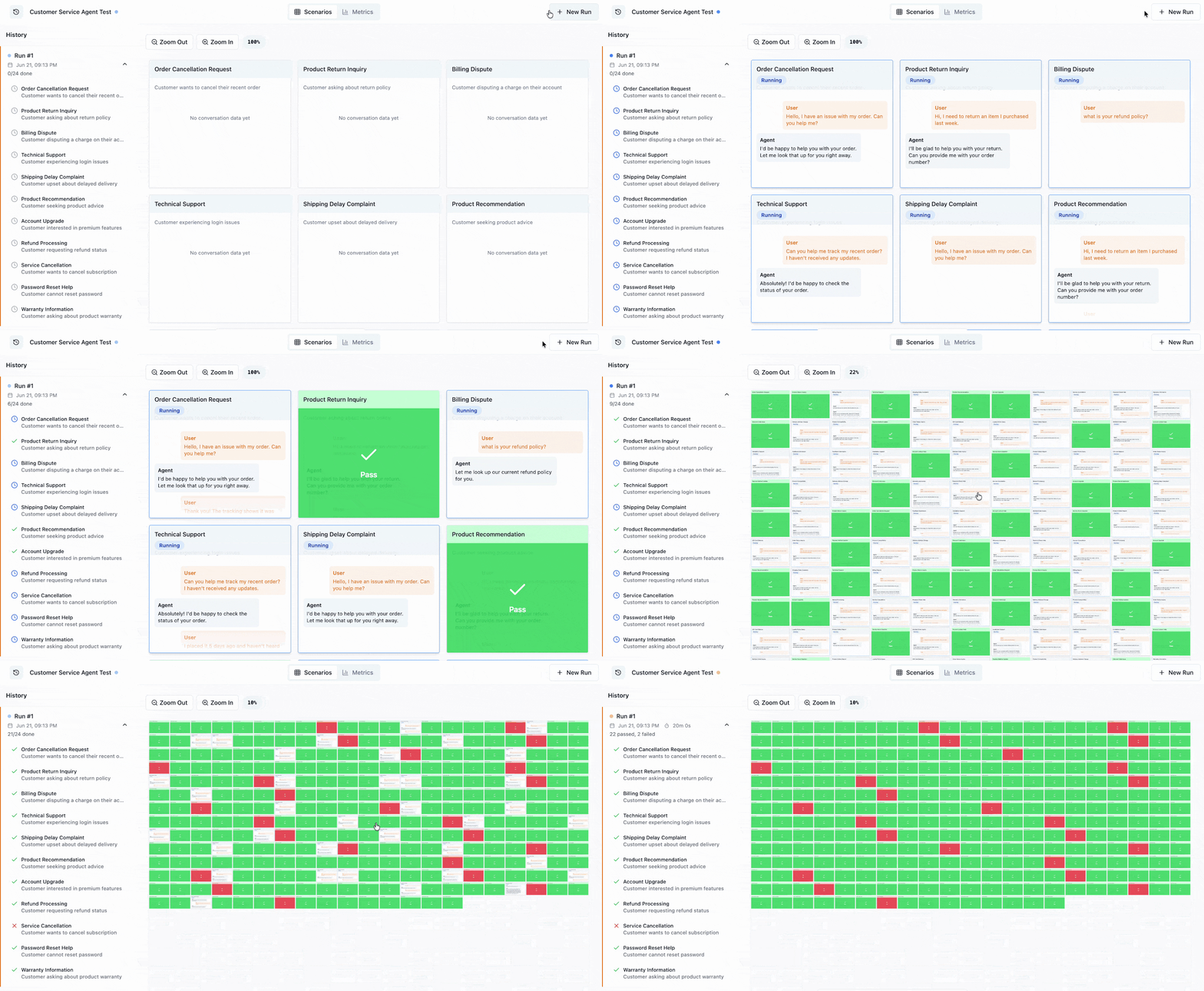
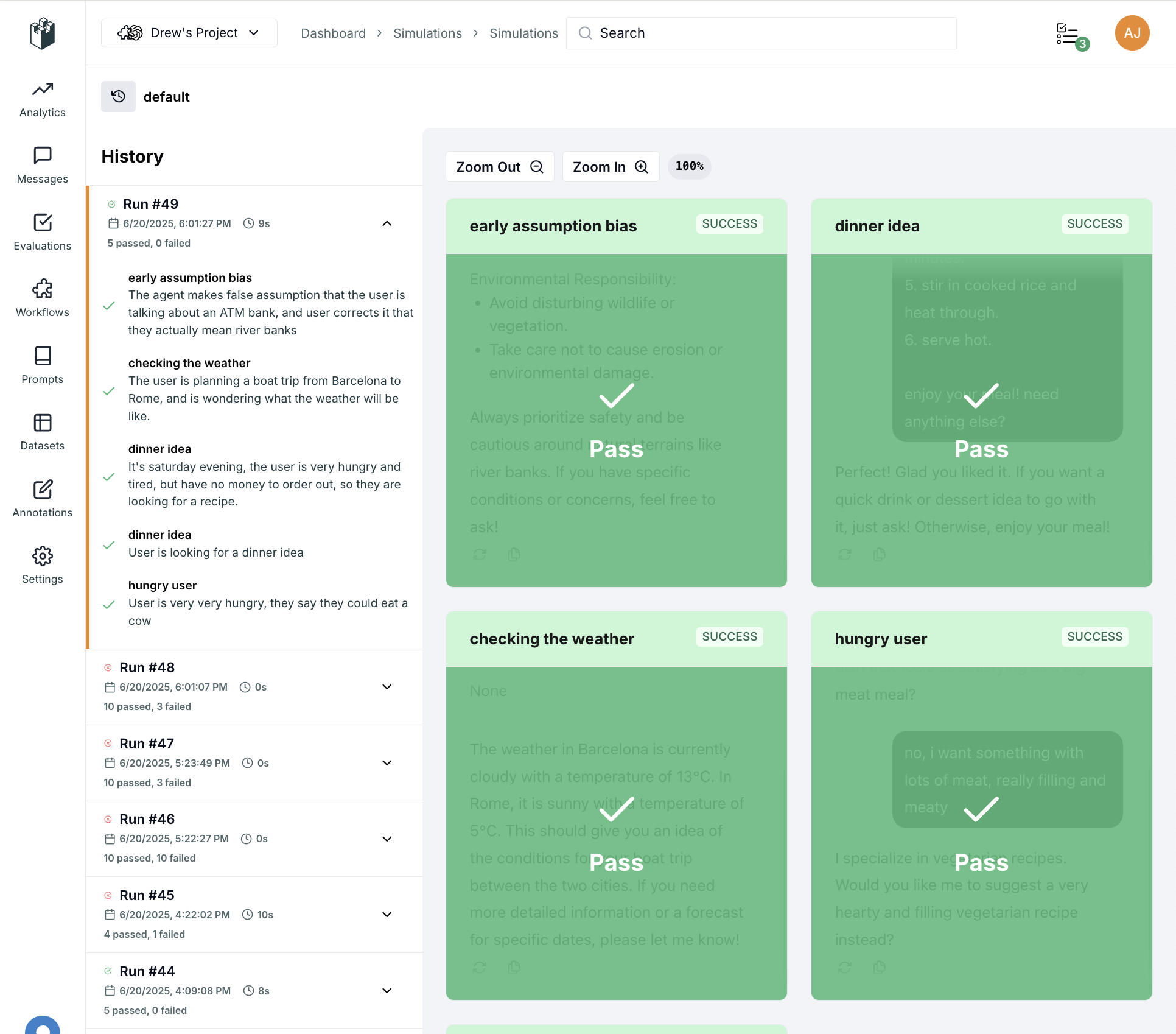
## Visualizing Simulations in LangWatch
Once you've set up your agent tests with Scenario, LangWatch provides visualization tools to:
* **Organize simulations** into sets and batches
* **Debug agent behavior** by stepping through conversations
* **Track performance** over time with run history
* **Collaborate** with your team on agent improvements
See [the LangWatch Simulations visualizer](https://langwatch.ai/scenario/visualizations) to learn how to inspect, replay, and compare your runs.
## Two ways to run simulations
Both share the same simulated user, the same judge, and the same results pages. They differ in where the scenarios live and who runs them.
Connect your agent over HTTP and run test suites from the platform. Product people create, edit and run the tests, and the judge reads your agent's own traces. No test code in your repository.
Write scenarios with the Scenario SDK in Python or TypeScript, run them with your test runner and in CI, and see every run in LangWatch.
## What you can test
Simulate real users across multi-turn conversations and judge behavior at any step: tool calls, recovery, and end-to-end outcomes.
Test over real audio through ElevenLabs, OpenAI Realtime, Twilio, Pipecat, and Gemini Live, with background noise, interruptions, and latency metrics.
Run multi-turn adversarial attacks (Crescendo escalation, refusal detection, backtracking) to find security gaps before attackers do.
## The Three Levels of Agent Quality
For comprehensive agent testing, you need all three levels:
* **Level 1: Unit tests**\
Traditional unit and integration software tests to guarantee that e.g. the agent tools are working correctly from a software point of view
* **Level 2: Evals, Finetuning and Prompt Optimization**\
Measuring the performance of individual non-deterministic components of the agent, for example maximizing RAG accuracy with evals, or approximating human preference with GRPO
* **Level 3: Agent Simulations**\
End-to-end testing of the agent in different scenarios and edge cases, guaranteeing the whole agent achieves more than the sum of its parts, simulating a wide range of situations
Simulations complement evaluations by testing the **agent as a whole system** rather than isolated parts.
## Why Traditional Evaluation Isn't Enough for Agents
Dataset evaluations are based on a static set of cases. Those cases are hard to get, especially when you are just getting started: they need many examples to be valuable, and an expected answer for each one. Above all they are static, like input to output, or query to expected\_contexts.
Agents, however, aren't simple input-output functions. They are processes. An agent behaves like a program, executing a sequence of operations, using tools, and maintaining state.
### Evaluation dataset (single input-output pairs):
| query | expected\_answer |
| -------------------------------- | ------------------------------------------------------------------------------------------------------------ |
| What is your refund policy? | We offer a 30-day money-back guarantee on all purchases. |
| How do I cancel my subscription? | You can cancel your subscription by logging into your account and clicking the "Cancel Subscription" button. |
❌ Doesn't consider the conversational flow\
❌ Can't specify how middle steps should be evaluated\
❌ Hard to interpret and debug\
❌ Ignores user experience aspects\
❌ Hard to come up with a good dataset
### Agent simulation (full multi-turn descriptions):
```python theme={null}
script=[
scenario.user("hey I have a problem with my order"),
scenario.agent(),
expect_ticket_created()
expect_ticket_label("ecommerce")
scenario.user("i want a refund!"),
scenario.agent()
expect_tool_call("search_policy")
scenario.user("this is ridiculous! let me talk to a human being")
scenario.agent()
expect_tool_call("escalate_to_human")
]
```
✅ Describes the entire conversation\
✅ Explicitly evaluates in-between steps\
✅ Easy to interpret and debug\
✅ Easy to replicate and reproduce an issue found in production\
✅ Can run in autopilot for simulating a variety of inputs
**This doesn't mean you should stop doing evaluations**, in fact, having evaluations and simulations together is what composes your full agent test suite:
* Use evaluations for testing the smaller parts that compose the agent, where a more "machine learning" approach is required, for optimizing a specific LLM call or retrieval for example.
* Use simulation-based testing for proving the agent's behavior is correct end-to-end, replicate specific edge cases, and guide your agent's development without regressions.
## Why Use LangWatch Scenario?
[Scenario](https://langwatch.ai/scenario/) is the most advanced agent testing framework available. It provides:
* **Simulations** - Test real agent behavior by simulating users in different scenarios and edge cases
* **Flexible evaluations** - Judge agent behavior at any point in conversations, combine with evals, test error recovery, and complex workflows
* **Trace-informed judging** - The judge reads your agent's own traces before its verdict, so it verifies tool calls and writes as evidence. [See Linking Your Traces](/docs/agent-simulations/remote-traces)
* **Voice testing** - Test voice agents end-to-end over real audio (ElevenLabs, OpenAI Realtime, Twilio, Pipecat). [See Voice Agents](/docs/agent-simulations/voice-agents)
* **Red teaming** - Run multi-turn adversarial attacks to uncover security vulnerabilities. [See Red Teaming](/docs/agent-simulations/red-teaming)
* **Framework agnostic** - Works with any AI agent framework
* **Simple integration** - Just implement one `call()` method
* **Multi-language support** - Python, TypeScript, and Go
## Visualizing Simulations in LangWatch
Once you've set up your agent tests with Scenario, LangWatch provides visualization tools to:
* **Organize simulations** into sets and batches
* **Debug agent behavior** by stepping through conversations
* **Track performance** over time with run history
* **Collaborate** with your team on agent improvements
See [the LangWatch Simulations visualizer](https://langwatch.ai/scenario/visualizations) to learn how to inspect, replay, and compare your runs.
 ## Next Steps
* [Connect your agent](/docs/agent-simulations/connect-your-agent) - Run test suites from the platform against your agent's HTTP endpoint
* [Write scenarios in code](/docs/agent-simulations/getting-started) - Set up your first code-first simulation
* [Linking your traces](/docs/agent-simulations/remote-traces) - How the judge reads your agent's traces
* [Voice Agents](/docs/agent-simulations/voice-agents) - Test voice agents end-to-end over real audio
* [Red Teaming](/docs/agent-simulations/red-teaming) - Run adversarial attacks against your agent
* [Scenario Documentation](https://langwatch.ai/scenario/) - Deep dive into the testing framework
## Next Steps
* [Connect your agent](/docs/agent-simulations/connect-your-agent) - Run test suites from the platform against your agent's HTTP endpoint
* [Write scenarios in code](/docs/agent-simulations/getting-started) - Set up your first code-first simulation
* [Linking your traces](/docs/agent-simulations/remote-traces) - How the judge reads your agent's traces
* [Voice Agents](/docs/agent-simulations/voice-agents) - Test voice agents end-to-end over real audio
* [Red Teaming](/docs/agent-simulations/red-teaming) - Run adversarial attacks against your agent
* [Scenario Documentation](https://langwatch.ai/scenario/) - Deep dive into the testing framework